

I’ve seen it happen many times. A conversation about risk financing is moving productively until the word captive comes up. The discussion shifts from the company’s objectives to the structure itself.
I recall speaking with a finance leader who was enthusiastic about retaining more of the company’s predictable risk. We discussed the economics, the company’s loss history, and the benefits of taking a more deliberate approach to risk financing. Then I mentioned utilizing a captive. Nothing about the strategy changed, but the conversation did.
That reaction is more common than many people realize. The term captive often comes with assumptions formed by past experiences, secondhand stories, or simple unfamiliarity. As a result, people sometimes form an opinion about the structure before they’ve had a chance to evaluate the idea behind it.
I understand the reaction. A captive can sound more complicated than a traditional insurance policy, and most finance leaders are reluctant to embrace a structure they do not fully understand. That’s a reasonable response. Risk-financing decisions deserve careful evaluation.
So let me start with a simple definition.
A captive is an insurance company that a business, or a group of businesses, owns or rents to insure its own risks. Instead of transferring every dollar of risk to the commercial market, the company finances a portion of that risk through a captive structure. The captive may be wholly owned, shared with other organizations, or accessed through a rented cell. The structure can vary, but the concept remains the same: a more direct role in how risk is financed.
Everything else builds from there.
Where the word picked up its baggage
If the concept is that simple, why does the word land so hard?
In my experience, the reaction usually comes from one of three places. Sometimes a company had a genuinely bad experience with a captive years ago. Sometimes the concern comes from a story heard from a colleague or industry peer. And often, there was never a negative experience at all... the concept was simply never explained clearly the first time.
That last category is the most common, and the most fixable. When a structure isn’t well understood, people naturally focus on what might be missing rather than what is being presented.
A better spreadsheet rarely solves that problem. A better explanation usually does. Once the mechanics are clear, the discussion becomes less about the word captive and more about whether the approach makes sense for the business.
Understanding the mechanics helps put the concept into context.
It’s the same cast, made visible
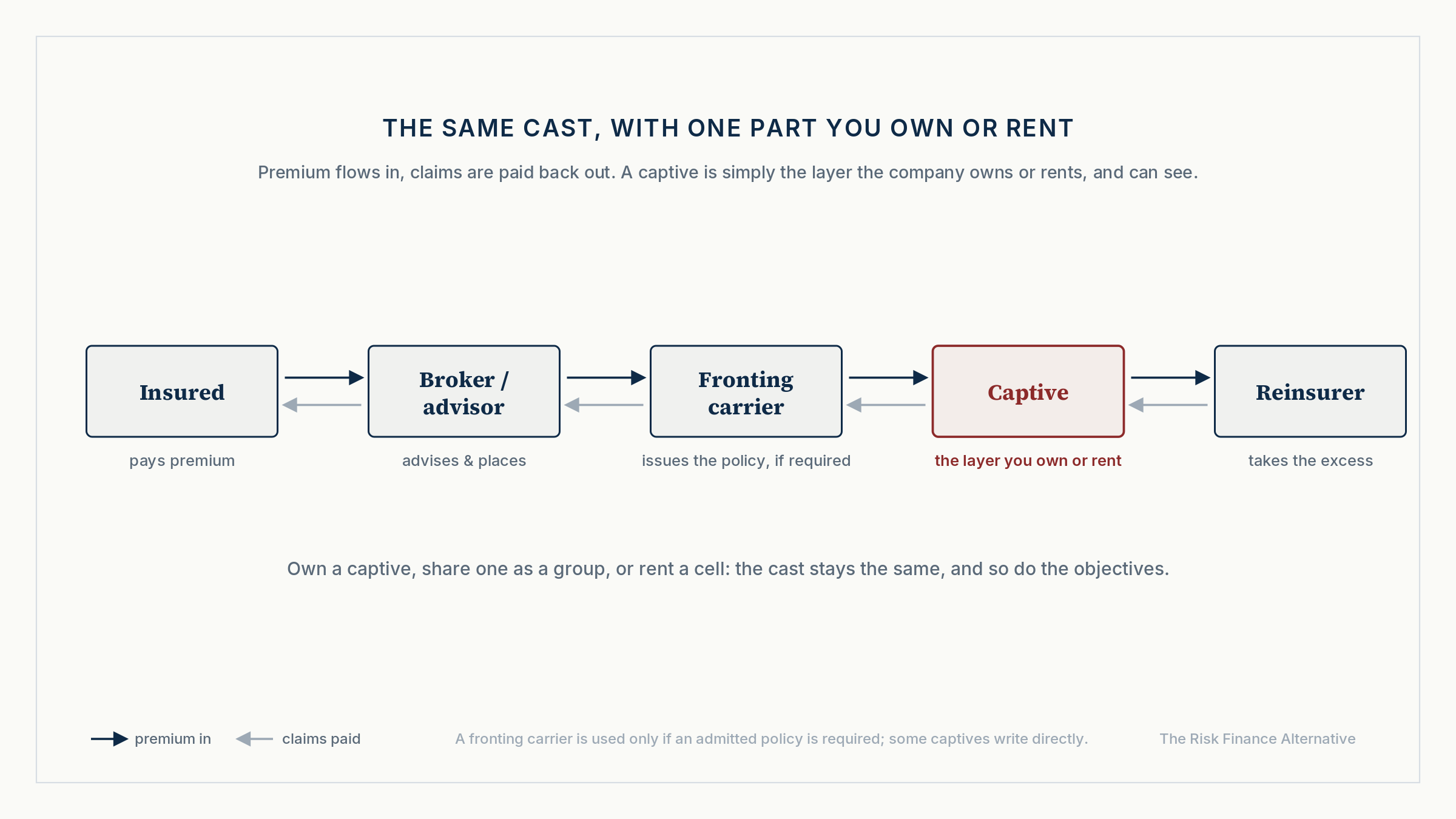
A captive is not an entirely different insurance system. The cast is largely the same as the one already at work in a traditional insurance program. There’s the insured, paying premium. There’s a broker or advisor who helps design and place the program. There’s a carrier issuing the policy. And behind that carrier, there is often a reinsurer, assuming some portion of the risk. Premium flows along that chain, and claims are paid back out along it.
A captive doesn’t introduce an entirely new set of participants. What changes is the company’s role. Rather than transferring all risks to third parties, the company owns, shares, or rents a vehicle that finances a portion of the risk itself. In some structures, a fronting carrier sits between the insureds and the captive, issuing the policy and passing risk through to the captive. In others, the captive writes the coverage directly. The details vary, but the basic cast remains familiar.
The important difference is visibility. In a traditional insurance arrangement, the company typically sees a premium and a policy. It may have little insight into how much risk is ultimately retained by the carrier, and how much is transferred elsewhere. A captive gives the company a more direct role in those decisions and a clearer view of how its risk is being financed.
Why companies explore captives
Companies generally explore captives for three reasons: greater control over how risk is financed, potentially improved economics over time, and access to coverage solutions that may not be available or practical in the traditional market. Enhanced transparency, stability, and flexibility often follow those core benefits.
Here’s the part that matters most: many of these objectives can be reached regardless of the structure. Whether a company owns a single-parent captive, participates in a group captive, or rents a cell, the underlying goals are often the same. The choice of structure is largely a question of scale, resources, and commitment, not whether potential benefits exist.
None of this is magic, and none of it is a loophole. It’s simply a more deliberate approach to financing risk. Rather than relying entirely on the traditional market, a company takes a more active role in deciding which risks to transfer and which risks to retain.
So the word isn’t the problem
At its core, a captive is simply one way for a company to participate more directly in financing its own risk. Whether that makes sense depends on the organization’s size, loss profile, capital position, and long-term objectives. For some companies, the answer will be yes. For others, traditional insurance will remain the better fit.
The important point is that the decision should be driven by an understanding of the structure rather than assumptions about the label. Once the mechanics become clear, the conversation tends to shift from “What is a captive?” to the more useful question: “Does this approach make sense for our business?”
That’s the purpose of this series of articles: to make risk-financing concepts easier to understand so companies can evaluate them on their merits.
One question I’m sitting with
I’ve found that many people’s initial impressions of captives were formed years ago, often from a brief conversation, a headline, or someone else’s experience. Sometimes those impressions are accurate. Sometimes they are overdue for a second look.
So, I’m curious: when you hear the word captive, what’s the first thing that comes to mind? And where did that impression come from? Hit reply and let me know. Your answers help shape the topics I’ll cover next.