

A capable business owner will tell you, with real confidence, “We don’t self-insure.” And almost every time, their program already carries meaningful deductibles across several lines.
Here’s the part that’s easy to miss: a deductible is self-insurance. When a company agrees to cover the first $25,000, $100,000, or $500,000 of every claim, it is already financing that layer of risk itself. The real question was never whether risk is retained. It’s whether that retained risk is understood, measured, and actually managed.
That’s where the gap usually shows up. Most companies aren’t misjudging their risk. They’re mis-measuring it. The risk they keep sits scattered across deductibles, policies, and renewals, looked at one line at a time but never pulled together into a single, clear picture.
It’s a dial, not a switch
Retaining risk was never an all-or-nothing choice. It isn’t a switch with two settings. It’s a dial, and it turns across a full spectrum, from transferring almost everything to an insurer to financing most of the risk yourself.
At one end of that spectrum, a company transfers almost everything for a fixed premium, what the industry calls guaranteed cost. At the other, it finances its own risk through a structure it controls, like a captive. In between, where most companies already operate, sit deductibles, retentions, and hybrid designs.
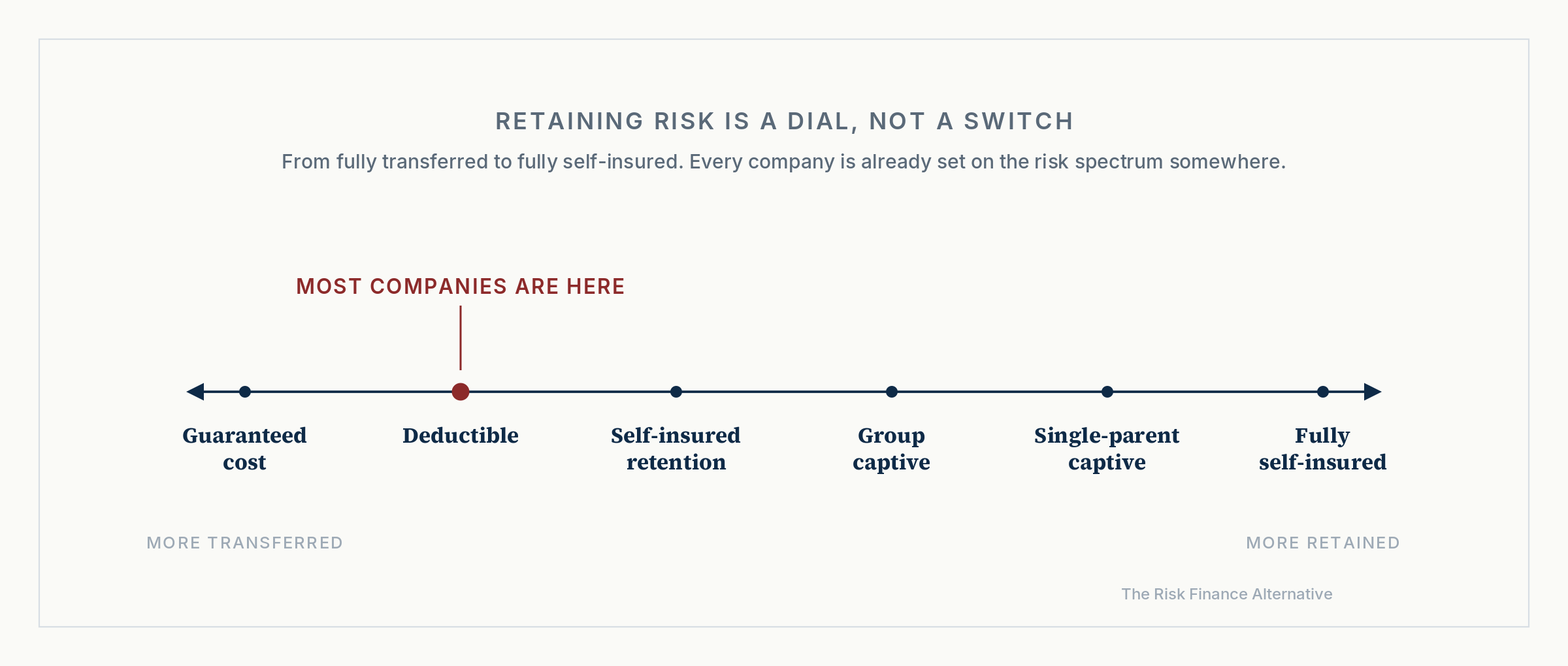
Every company has already set that dial somewhere. The only real question is whether the setting was chosen on purpose, or simply inherited.
What’s actually at stake
When a company retains risk without managing it, it tends to give away the value that comes with it.
Picture a genuinely good year, where losses land well below what the premium assumed. In a guaranteed-cost arrangement, that favorable result doesn’t come back to the company. It stays with the carrier. That isn’t anyone doing anything wrong. It’s how the structure works, and the carrier took on the risk that the year could have gone the other way. But when a company’s results come in better than its premium assumes, year after year, it may be paying to transfer volatility it already controls, andgiving up the economics that come with it.
This is where the conversation moves from price to total cost of risk. Managing the retained position on purpose is, at heart, a way to keep more of the value that good risk management already creates. No magic, no loophole, no gimmick. Just a more deliberate answer to a question every company is answering by default.
Why it usually goes unseen
If the opportunity is this consistent, why does it stay hidden?
It’s because retained risk rarely shows up as a single, visible number. It’s spread across deductibles, program design, and dozens of separate decisions, reviewed once a year but never added up or actively governed. So companies end up managing insurance programs, not risk positions.
The turning point is simple. When the full retained position is quantified and seen in one place, it stops being a byproduct and becomes something a company can manage with intent. At that point the question changes, from “what coverage should we buy?” to “what outcome are we trying to produce?”
Where this is heading
With that foundation set, the next issues get concrete. We’ll look at what it means to think like a risk financier rather than a coverage buyer, how the structures actually perform, and where companies tend to start before the approach matures over time.
This was never about moving all the way to self-insurance. It’s about bringing discipline, visibility, and control to a position companies already hold.
One question I’m sitting with
The next time an insurance program crosses your desk, step back from the individual policies and look at the whole. How much risk is the organization already financing, in total? And is that position being managed with the same discipline as any other line on the balance sheet?
Most companies have already set the dial. The ones that pull ahead set it deliberately, not by default.
That’s the gap I keep coming back to. Tell me what you see in your own world. It shapes what I write next.