

In my previous article, we explored a simple idea: every company is financing some of its own risk, whether intentionally or not. Which raises the obvious next question: how can a company strategically navigate and position itself along the spectrum?
The answer tends to surprise people, because it isn’t a structure, such as a captive, or a cell, or any of the vehicles we’ll discuss later. It’s quieter than that. It starts with which question gets asked first.
Two people, two questions
Picture two executives preparing for the same renewal.
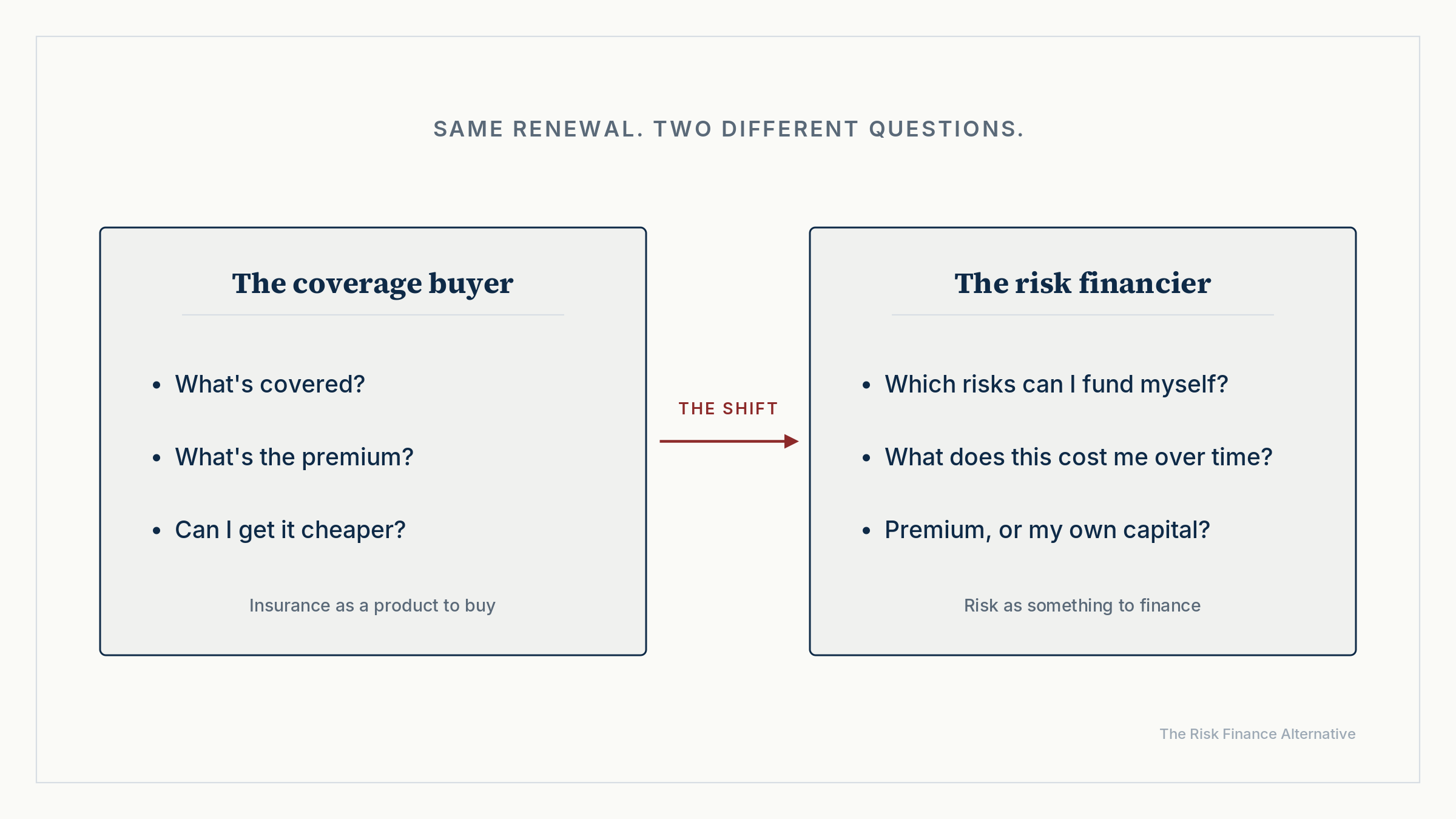
The first executive is a coverage buyer. The questions are familiar: What’s covered? What’s the premium? Can the same protection be had for less? Reasonable questions, and most of the market is built to answer them. In this frame, insurance is a product to purchase at the best price once a year.
The second executive is a risk financier. The questions change: Which of these risks does the company understand and control well enough to fund itself? What do they truly cost over time, not just at this renewal? Is the next dollar better spent on a premium, or on the company’s own capital? In this frame, risk is something to finance deliberately, over years, rather than hand off annually.
Same company, same risks, same renewal. Two very different conversations, decided entirely by which question came first.
From price to cost of risk
The coverage buyer optimizes the premium. The financier optimizes something larger, what the discipline calls total cost of risk: the premium, plus the losses a company retains, plus the cost of running the program, plus the cost of the capital it ties up. The premium is only one line in that total.
Once the whole cost comes into view, some things invert. The cheapest premium can carry the highest total cost of risk, and a higher premium can quietly turn out to be the better deal.
From one year to many
There’s a second half to the shift, which focuses on time.
Insurance is sold a year at a time, so we are trained to think a year at a time. But risk doesn’t arrive in neat annual boxes. It plays out over many years, in good stretches and bad. The financier looks at the multi-year picture, where a run of strong years can compound in a company’s favor rather than reset to zero at every renewal. As noted in my previous article, in a pure-transfer arrangement the reward for a good year tends to stay with the carrier. The multi-year view is what lets a company begin to keep some of that value.
Why this is the real unlock
Here’s the part worth holding onto. A company doesn’t need to be large to think like a financier. The mindset comes first, and the structures are simply tools that serve it. How much to retain, what the risk really costs, where capital works hardest: those questions are available to almost any well-run company today, at no cost.
This strategy still likely requires transferring risk and purchasing insurance. A good financier still transfers plenty: the catastrophic risks and the risks not well quantified or understood. The point was never to retain everything. It’s to decide deliberately, rather than by default.
Where this is heading
With the mindset in place, the next questions become practical. How much risk should a company retain? What structures fit its goals? How much capital should it commit? Those are the kinds of questions that advisors, captive managers, and risk-financing specialists help organizations work through every day. For companies exploring that path, strategic partners can help bridge the gap between understanding the principles of risk financing and putting them into practice through a program designed around their specific needs.
One question I’m sitting with
If the shift really is just a change in the opening question, then the most useful thing I can do is make the financier’s questions easy to hear. So, here’s what I keep wondering... in the renewals you come across, which question tends to come first: what it costs, or what it costs over time? Hit reply and tell me what you see. Your answer shapes what I write next.